



How to Choose Fire-Rated Access Panels That Pass Canadian Commercial Inspections
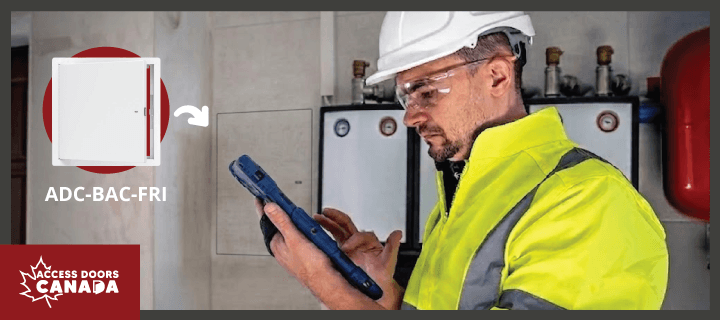
To pass commercial inspections in Canada, you need to choose fire-rated access panels that match the fire-resistance rating and listing of the surrounding wall or ceiling. They should also be installed exactly as tested and come with clear documentation you can present to the Authority Having Jurisdiction (AHJ).
If any of those pieces are missing, you risk failing inspections, delaying occupancy, and having to open up finished work to correct fire separation deficiencies.
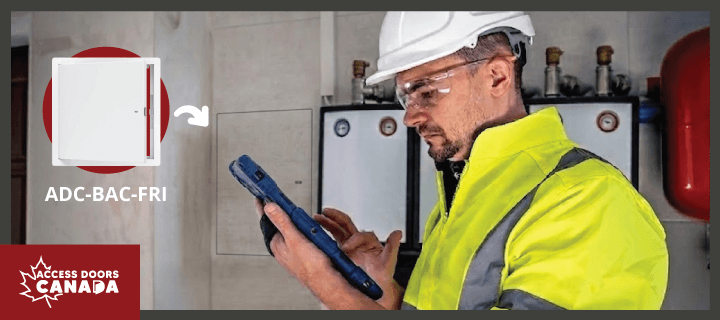
In this article, we’ll look at what Canadian inspectors expect from fire-rated access panels, the most common failure points, and how ADC-BAC-FRI access panel supports compliant fire separation.
What Do Canadian Inspectors Look for in Fire-Rated Access Panels?
Canadian inspectors primarily look for three things in fire-rated access panels: matching fire-resistance ratings, proper certification and labelling, and installation requirements that maintain the continuity of fire separations.
Let’s look at each expectation in detail.
Matching Fire-Resistance Ratings
Under the National Building Code of Canada, fire separations between occupancies and key zones must meet specific fire-resistance ratings. If any part of the separation (like an access panel) doesn’t meet that rating, the compartment is no longer considered complete.
Proper Certification and Labelling
Inspectors also check that the access panel is tested in accordance with the relevant Canadian standards. Fire-rated doors and access assemblies are typically evaluated in accordance with CAN/ULC S104, which covers testing for fire endurance and hose stream exposure.
This means that inspectors will look for a legible ULC mark on the access panel and frame that confirms the assembly has been tested and listed for use in fire separations. Without that mark, they have no easy way to verify that the product is appropriate for a rated assembly.
Installation, Operation, and Ongoing Condition
The inspectors will evaluate how the panel is installed and operates as part of the fire separation, not just how it looks on paper. As a result, they’ll expect:
- A self-closing and self-latching operation is required by code for closures in fire separations.
- No visible damage, gaps, or field modifications that could weaken the fire separation or reduce the fire-resistance rating.
- Proper firestopping and sealing around frames where panels penetrate rated walls or ceilings to maintain the compartmentation line.
- Maintenance and inspection practices that keep fire doors and closures in good working order, often including monthly checks under national and provincial fire codes.
Want to strengthen your inspection readiness? Explore our commercial fire-rated access doors to learn how our access panels meet commercial inspection standards in Canada.
What Common Mistakes Cause Fire-Rated Access Panels to Fail Inspection?
Most inspection failures of fire-rated access panels stem from rating mismatches, missing labels, and field modifications that compromise the tested assembly.
A few of the most common issues inspectors often flag include:
- Using non-rated panels in rated assemblies.
- Mismatched fire ratings.
- Missing or painted-over ULC labels.
- Improper hardware or disabled self-closing devices.
- Overcut or poorly framed openings.
- Lack of verified documentation.
How Must Access Panels Align with Fire-Rated Wall and Ceiling Assemblies?
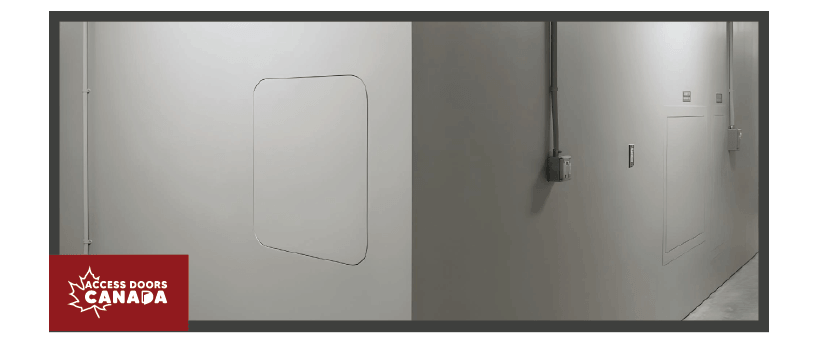
Access panels must align with fire-rated wall and ceiling assemblies by matching the fire-resistance rating, orientation, and tested construction details of the surrounding assembly to maintain the integrity of the fire separation during a fire.
This alignment typically includes:
- Equivalent rating: The panel’s rating must be equal to or greater than the required rating of the wall or ceiling (for example, a 2-hour panel in a 2-hour shaft wall).
- Correct orientation: Panels must be tested and listed for the orientation they’re used in. Some models are rated for walls only, others for ceilings, and some for both. Installing a “wall-only” unit in a rated ceiling can raise issues at inspection.
- Continuous framing and support: The surrounding framing must provide the structural support and edge conditions assumed in the fire test.
- Compatible firestopping at the perimeter: Where the access frame meets the rated wall or ceiling, appropriate firestopping and sealants must be used to maintain the integrity of the separation.
- Integration with other closures: In many projects, access panels share fire separations with fire doors, dampers, and other closures. The overall detail must maintain fire compartmentalization across the entire boundary.
Related: How Fire-Rated Access Doors Help Preserve Canadian Government Buildings
How Does ADC-BAC-FRI Support Compliant Commercial Fire Separation?
ADC-BAC-FRI Fire-Rated Insulated Access Panel supports compliant fire separation by combining a 2-hour fire rating, robust construction, and self-closing, self-latching hardware in a panel that’s designed specifically for fire-rated walls and ceilings in multi-tenant buildings.
From a construction standpoint, the ADC-BAC-FRI access panel offers:
- Durable frame and door: 16-gauge cold-rolled steel frame and 20-gauge galvanneal steel door for an impact-resistant assembly to withstand jobsite handling and day-to-day use.
- Deep frame profile: A 2½-inch-deep frame that helps transform roughly cut openings into clean, finished penetrations while preserving the integrity of the fire separation.
Inside the door, its fire and thermal performance are supported by:
- Mineral wool insulation: 2 inches of mineral wool that provides thermal resistance and improved performance under fire conditions.
- High-temperature resistance: Mineral wool designed to withstand temperatures over 2,000°F, helping the assembly resist heat transfer and support compartmentation objectives during a fire event.
Important note: Fire-rated access doors do not stop fires from starting; they help slow down the spread of a fire for a limited period.
For operation and inspection, ADC-BAC-FRI is built around features that align with NFPA 80 expectations. The components include:
- Self-latching slam latch options: A self-latching, tool-key operated slam latch and/or ring-operated slam latch so the door reliably secures when closed.
- Automatic panel closer: A standard automatic closer on all doors that helps the panel return to the closed position without relying on occupants.
- Continuous piano hinge: A continuous piano hinge mounted on the second dimension (height) to keep the door aligned in the frame and reduce the risk of binding or misalignment that could interfere with closing.
- Inside panel release on larger sizes: An inside panel release on larger doors so maintenance teams can open the panel from the inside while maintaining the fire-resistance rating.
From a sustainability and documentation standpoint, ADC-BAC-FRI contributes to broader project goals through:
- Recycled content mineral wool: Mineral wool with recycled content that supports LEED v4 and Canadian green building strategies when coordinated with compliant coatings and finishes.
- High-quality finish: A high-quality white powder coat primer that arrives ready for field painting, so the panel blends with surrounding finishes.
ADC-BAC-FRI can also be configured with options such as stainless-steel construction, masonry anchors, and alternate lock types to match specific occupancies, while staying within the framework of tested, code-compliant fire-rated assemblies.
Need project-specific pricing for ADC-BAC-FRI access panel? Request a quote for ADC-BAC-FRI to align your wall and ceiling details with fire separation requirements.
Frequently Asked Questions on Fire-Rated Access Panels in Canada
1. When should fire-rated access panels be specified to avoid rework?
You should specify fire-rated access panels at the same time you define your fire separations and rated assemblies, which is typically during design development and early coordination with mechanical, electrical, and fire protection trades.
2. Do access panels in fire-rated walls and ceilings always need a fire rating in Canada?
Yes. When an access panel penetrates a fire-rated wall or ceiling, it should meet the same fire-resistance standards as the surrounding assembly. Non-tested or non-listed panels are generally prohibited in fire-rated construction because they compromise the integrity of the separation and can cause the compartment to fail its fire-resistance rating.
3. Can you retrofit a fire-rated access panel into an existing rated wall without losing the rating?
You can retrofit a fire-rated access panel into an existing rated wall, but only if the opening is created, framed, and fire stopped in accordance with the panel manufacturer’s instructions and applicable codes.
The National Fire Code of Canada requires that damaged or altered fire separations be repaired so that their integrity is maintained. This includes when you cut new openings after initial construction.
To Sum It Up
Passing commercial inspections in Canada often comes down to how you treat access panels as part of your fire separations.
To get approval, you’ll need code-listed, clearly labelled panels that match the fire-resistance rating of their walls and ceilings. They should also be installed according to the tested details and be backed by verified documentation that ties them into your overall code-compliance strategy.
Contact our team or call +1-888-327-5471 if you’re planning a new build or major retrofit and want to coordinate fire-rated access panels from the start. We’ll help you match code-compliant access panels to your assemblies in Canada, so your next inspection goes as smoothly as possible.


