
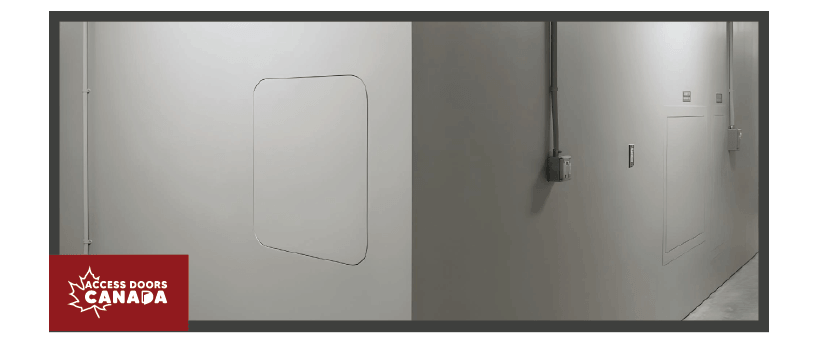




What Airtight Access Panels Support Building Envelope Performance?
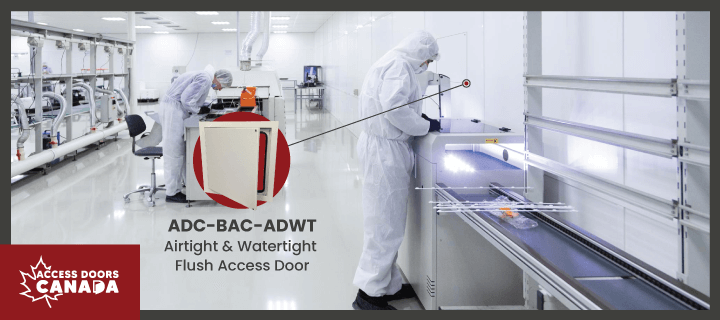
The best airtight access panels that support building envelope performance combine durable construction and verified air-leakage ratings. They also feature gasketed seals that integrate seamlessly with the air barrier.
When access doors are overlooked or poorly specified, they can become weak points in an otherwise well-designed envelope system. The result? Air leakage, heat loss, and moisture intrusion all of which reduce energy efficiency and increase the risk of energy code non-compliance.
In this article, we’ll explain why airtight access panels matter and what features to prioritize. We’ll also look at how the ADC-BAC-ATWT Airtight & Watertight Flush Access Door helps Canadian commercial projects meet the demands of modern cold-climate envelope design without sacrificing functionality or compliance.
How Does Airtight Construction Improve Energy Efficiency?
Airtight construction reduces heat loss, improves HVAC performance, and enhances interior comfort.
When buildings leak air, heating and cooling systems have to work overtime. This results in inconsistent temperatures, increased wear and tear on your HVAC systems, and higher energy costs.
In contrast, a well-sealed building envelope maintains consistent indoor conditions, which reduces energy use, extends the lifespan of the HVAC system, and improves occupant comfort.
Airtightness is also essential for meeting Canada’s energy codes, including the NECB and BC Energy Step Code, which set strict performance targets for commercial buildings.
Why Do Access Panels Affect Building Envelope Performance?
Access panels affect building envelope performance because every opening in the wall or ceiling is a potential air-leakage and moisture-entry point. If those openings aren’t sealed with airtight panels, they become major pathways for leaks, leading to uncontrolled airflow, heat loss, and higher energy bills.
These seemingly small openings can undermine even the most well-designed envelope systems. That’s why using air barrier access panels like the ADC-BAC-ATWT, with built-in gasketing and welded seams, can make a huge difference in how your building envelope performs.
If you're designing a building to be airtight, you need to start with the components that support it. Explore our airtight access panels built to protect your building envelope performance.
What Features Make an Access Panel Truly Airtight?
Airtight access panels, like the ADC-BAC-ATWT, often have a steel door and frame, EPDM co-extruded trim-seal gasket, and undergo verified performance testing.
It’s important to note that just because an access panel is labeled “airtight” doesn’t mean it will perform that way in the field. That’s why it’s crucial to look for key features that back up the claim.
These features include:
- Fully welded construction to reduce deformation and maintain consistent sealing over time.
- Durable EPDM gasketing to provide a reliable seal under pressure and prevent air leaks across a wide clamping range.
- Third-party air and water testing compliance to meet industry benchmarks like ASTM E283 for air leakage and ASTM E331 for water resistance.
- Low air leakage rate to support airtight construction goals and pass blower-door testing with rates below 0.1 L/s/m² (<0.01 cfm/ft²) when properly installed.
How Do Airtight Access Panels in Canada Support Blower-Door Testing and Code Compliance?
Airtight access panels support blower-door testing and code compliance by preserving the continuity of the building’s air barrier. This reduces the risk of test failures and non-compliance with the National Energy Code of Canada for Buildings (NECB) and provincial energy codes.
During a blower-door test, even small leaks around access points can contribute significantly to a building’s total air change rate. These leakage paths are especially problematic in commercial buildings where mechanical, electrical, or plumbing systems are hidden behind walls and ceilings.
When standard, unsealed access panels are used, they often require last-minute field taping or caulking, which isn’t durable or consistent. Airtight models, on the other hand, are built with gasketing, rigid frames, and welded seams that eliminate these gaps from the start.
Models like the ADC-BAC-ATWT are pre-tested to meet code-level performance, which simplifies NECB compliance, and minimizes costly rework during inspection.
Need help specifying airtight access doors? Talk to our Canadian experts. We’ll help you choose the right panel for your project.
Which Access Doors Canada Models Best Support Envelope Performance?
The ADC-BAC-ATWT is one of the best access doors models that supports building envelope performance. It's engineered for airtightness, water resistance, durability, and energy efficiency in demanding environments.
Here are some of the features that makes it stand out:
- 16-gauge steel door and frame: Provides structural rigidity that resists warping, ensuring consistent contact with gaskets and preventing seal degradation over time.
- Fully welded construction: Minimizes air bypass opportunities along panel seams, delivering a seamless interface with the wall or ceiling system.
- 5" trim with integrated gasketing: Ensures full surface contact for airtightness and a smooth transition between door and surrounding envelope.
- EPDM co-extruded trim-seal gasket: Offers a secure clamping range (0.040"–0.118") to absorb thermal movement without compromising the seal, which is especially critical in cold-climate buildings.
- Continuous piano hinge: Maintains even compression across the entire door edge, reducing weak spots and improving durability with repeated use.
- ASTM E283 and E331 tested: Independently verified for both air and water infiltration, giving specifiers confidence during envelope modeling and compliance testing.
- Leakage rating <0.1 L/s/m² (<0.01 cfm/ft²): Meets or exceeds the tightness thresholds for NECB and blower-door requirements when installed according to the instructions.
The ADC-BAC-ATWT is a strong fit for projects where airtightness, durability, and code compliance are non-negotiable. These include:
- Healthcare and pharmaceutical facilities
- Clean rooms and laboratories
- Commercial buildings in cold-climate zones
- LEED and Step Code projects
- Mechanical rooms requiring R-value insulation and gasketed access
By choosing an energy-efficient access door like the ADC-BAC-ATWT, you reduce the risk of thermal bridging, improve air sealing performance, and eliminate a common source of leakage in the building envelope.
Frequently Asked Questions About Using Building Envelope Access Doors in Commercial Projects
1. How do I know if an access panel is airtight?
Look for independent air leakage testing, gasketed seals, and welded construction. A true airtight panel should have been tested to ASTM E283 standards, have a documented air leakage rating (e.g., <0.1 L/s/m²), and include components like EPDM gasketing and fully welded frames to prevent bypass leakage.
2. Can airtight access panels help pass a blower-door test?
Yes, especially if they’re installed at high-risk leakage points like mechanical rooms and service shafts. Poorly sealed access doors are a common reason for failing blower-door tests, which measure total air leakage. Installing airtight, tested panels helps reduce leakage pathways and increases your chances of passing on the first attempt, especially on NECB- or Step Code-compliant projects.
3. Where should airtight access panels be used in commercial buildings?
Airtight access panels should be used anywhere they penetrate an air barrier or moisture-sensitive envelope system to maintain air barrier continuity. Ideal locations include mechanical rooms, clean rooms, hospitals, and any service area behind an air barrier. In these areas, a standard unsealed panel can create uncontrolled airflow that compromises both energy performance and moisture management.
4. What’s the difference between insulated and airtight access panels?
Insulated access panels reduce heat transfer (R-value), while airtight access panels stop air movement. For envelope-critical projects, you’ll often need panels that are both insulated and airtight.
Airtightness controls air leakage and moisture intrusion, while insulation controls thermal bridging and heat loss. The ADC-BAC-ATWT is designed to handle both, making it a solid choice for high-performance buildings.
To Sum It Up
Access panels play an active role in maintaining the integrity of the building envelope. If they allow air or moisture to leak, they can compromise insulation, weaken thermal bridging control, raise energy bills, and lead to code violations.
The ADC-BAC-ATWT Airtight & Watertight Flush Access Door is engineered to meet these challenges head-on. With its durable steel construction, performance-tested seals, and cold-climate readiness, professionals across Canada trust it to deliver reliable envelope performance.
Ready to protect your building envelope with a tested, code-compliant access solution? Request a quote today for insulated, gasketed access panels with nationwide delivery. You can also call +1-888-327-5471 to talk to our specialists directly.


