




What Are Acoustic Access Panels and How Do They Improve Noise Control in Commercial Buildings?
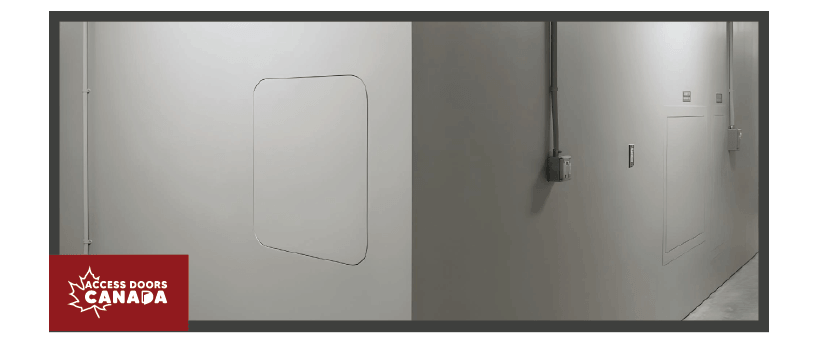
Acoustic access panels are sound-rated doors installed in walls or ceilings that allow service access without compromising noise control. They improve acoustic performance in commercial buildings by preventing sound leakage through access openings and helping maintain the Sound Transmission Class (STC) ratings of sound-rated partitions.
Commonly used in offices, hospitals, hotels, and educational facilities, commercial acoustic solutions are engineered with sound-absorbing cores, tight perimeter seals, and rigid frames to block airborne noise, reduce vibration, and preserve privacy and occupant comfort, without restricting access to critical building systems.
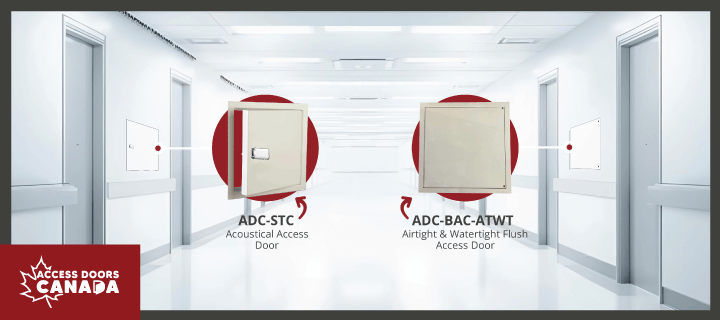
Commercial projects often rely on sound-rated access solutions such as the ADC-STC Acoustical Access Door – Karp and the ADC-BAC-ATWT Airtight & Watertight Flush Access Door to maintain acoustic performance.
In this article, we’ll discuss what acoustic access panels are and why they play a key role in effective noise control.
What Is an Acoustic Access Panel and How Does It Differ from a Standard Panel?
An acoustic access panel is a purpose-built access door or hatch engineered to limit sound transmission through wall and ceiling assemblies. Unlike standard access panels, which prioritize basic access and visual integration, acoustic access panels are designed with noise control as a primary performance requirement.
Standard access panels typically use lightweight materials and minimal sealing, creating a weak point in sound-rated partitions through which airborne noise can pass. In commercial buildings with defined noise control requirements, this can undermine the performance of an otherwise compliant wall or ceiling assembly.
By using heavier materials, internal acoustic insulation, precision-fitted frames, and continuous perimeter seals, an acoustic access panel reduces sound transfer at access points. This construction allows necessary service access while maintaining the intended acoustic performance of the overall assembly.
Need acoustic access panels that support reliable noise control in commercial environments? Contact us today to discuss sound-rated solutions and customization options designed to align with your project requirements.
Why Do Access Panels Often Cause Noise Control Issues in Commercial Buildings?
Access panels often cause noise control problems because they are treated as minor accessories rather than critical acoustic components. In many projects, acoustic performance is addressed at the wall or ceiling level, while penetrations are specified late or substituted without considering sound performance.
Sound naturally travels through the weakest point in an assembly. Even a high-performing acoustic wall assembly can fail if a non-acoustic panel is installed within it. This creates a direct path for noise leakage, particularly airborne sound from mechanical rooms, electrical spaces, or service corridors.
These issues are especially problematic in healthcare and office acoustics, where speech privacy, concentration, and comfort are essential. Mechanical room noise bleeding into patient rooms or meeting spaces is frequently traced back to poorly specified access panels. Once the building is occupied, fixing these problems is disruptive and expensive, often requiring panel replacement and finish repairs.
Related: What Is the Purpose of Acudor’s Soundproof Access Doors?
How Do Acoustic Ratings and Panel Construction Affect Sound Transmission?
The performance of acoustic access panels depends on both acoustic ratings and construction quality. Most sound-rated access panels are evaluated using STC ratings, which indicate how effectively a component reduces airborne sound.
Panel mass is a key factor in achieving higher STC performance. Heavier panels block sound more effectively than lightweight alternatives. Internal acoustic insulation further reduces sound energy passing through the panel. However, these elements must be supported by proper sealing.
Perimeter gaps are one of the most common causes of acoustic failure. Even small openings around a panel can significantly reduce sound transmission control. High-quality acoustic access panels use continuous gaskets and rigid frames to maintain tight seals when closed.
Installation detailing is equally important. Panels must be properly aligned, securely fastened, and sealed to the surrounding acoustic wall assemblies. Without correct installation, even well-designed panels may fail to deliver the expected noise leakage prevention.
How Do ADC-STC and ADC-BAC-ATWT Support Acoustic Performance in Wall and Ceiling Assemblies?
The ADC-STC Acoustical Access Door – Karp and the ADC-BAC-ATWT Airtight & Watertight Flush Access Door support acoustic performance by preventing sound and air leakage at service access points, allowing wall and ceiling assemblies to maintain their intended noise control ratings. Access openings are one of the most common points of acoustic failure, and products are engineered to address this condition without restricting required access.
ADC-STC Acoustical Access Door – Karp
The ADC-STC Acoustical Access Door – Karp is designed for applications requiring high sound isolation. Its construction aligns with sound-rated wall and ceiling assemblies to reduce airborne sound transmission where access is required.
Acoustic performance is supported through:
- Independently tested STC 64 performance in accordance with ASTM E1332 and E413
- High-mass door construction that limits vibration and sound transmission
- Internal acoustic insulation that absorbs sound energy
- Precision-fitted frame and continuous perimeter seals that eliminate sound leakage paths.
This makes the ADC-STC access panel suitable for noise-sensitive commercial spaces such as studios, conference rooms, healthcare facilities, and educational buildings.
ADC-BAC-ATWT Airtight & Watertight Flush Access Door
The ADC-BAC-ATWT Airtight & Watertight Flush Access Door supports acoustic performance by controlling air movement, which is a primary contributor to airborne sound transfer. While designed for airtight and watertight applications, its sealing system and construction also enhance noise control at access locations.
Performance is supported through:
- Continuous airtight and watertight seals that restrict air and sound leakage
- Heavy-duty steel construction that adds mass to the assembly
- Flush installation that preserves wall and ceiling continuity.
The ADC-BAC-ATWT access door is commonly used in clean rooms, laboratories, hospitals, and controlled environments where both environmental control and sound containment are required.
Considering these products for a commercial build or renovation? Request a quote, and our team will help ensure alignment with project specifications and timelines.
Where Should Acoustic Access Panels Be Prioritized in Commercial Projects?
Acoustic access panels should be prioritized wherever noise control is critical and access to services is required. Mechanical rooms are a primary example, as they are common sources of persistent noise complaints. Panels separating these spaces from occupied areas should always be sound-rated.
Healthcare facilities are another high-priority application. Patient rooms, consultation areas, and treatment spaces rely on effective noise control to support privacy and recovery, and even minor sound leakage through access panels can compromise these environments.
In all cases, access panel noise reduction performance should be evaluated with the same rigour as doors, walls, and ceilings. When specifying products such as ADC-STC and ADC-BAC-ATWT in these noise-sensitive environments, confirm that the panel rating is appropriate for the specific application and surrounding construction. Otherwise, the access panel can undermine the intended acoustic performance.
Frequently Asked Questions on Acoustic Access Panels
1. How do acoustic access panels improve noise control in commercial buildings?
They use higher-mass construction, internal acoustic insulation, and perimeter seals to reduce sound leakage and help maintain the intended acoustic performance of walls and ceilings.
2. Why should acoustic access panels be specified early in the design phase?
Specifying acoustic access panels early helps ensure they are coordinated with acoustic wall assemblies, prevents late substitutions, and reduces the risk of sound leakage discovered during testing or after occupancy.
3. Do acoustic access panels contribute to failed acoustic testing if overlooked?
Yes. Non-acoustic access panels are a common cause of failed acoustic testing because they allow sound to bypass otherwise compliant wall or ceiling assemblies.
4. How do acoustic access panels support long-term building performance?
High-quality acoustic access panels maintain seal integrity and sound control over time, supporting consistent acoustic performance throughout the building’s lifecycle.
To Sum It Up
Acoustic access panels improve noise control in commercial buildings by ensuring that service openings do not compromise the performance of sound-rated wall and ceiling assemblies. When properly selected and detailed, they play a critical role in reducing sound leakage, supporting successful acoustic testing, and maintaining occupant comfort in noise-sensitive environments.
At Access Doors Canada, we ensure that acoustic access panels are specified with real-world construction and long-term performance considerations. By supporting consistent acoustic integrity across access points, we help project teams reduce coordination issues, avoid post-installation remediation, and deliver buildings that perform as intended from occupancy onward.
For commercial projects where noise control, compliance, and durability are critical, our team provides practical guidance to support informed access panel decisions. Call +1-888-327-5471 to speak with a specialist and ensure your access solutions align with project requirements.


