



Which Canadian-Compliant Access Panels Do Architects and Contractors Specify Most for High-Rise Buildings?
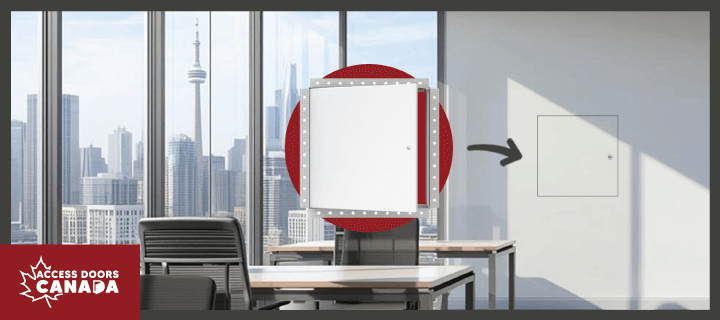
Architects and contractors most often specify fire-rated, code-listed steel access panels such as the ADC-BAC-FRI Fire-Rated Insulated Access Door for high-rise projects because they preserve rated assemblies, satisfy Authority Having Jurisdiction (AHJ) requirements, and reduce inspection risk.
When improperly selected, access panels can compromise fire separations, delay approvals, and create costly rework requirements.
In this article, we’ll discuss which Canadian-compliant access panels are most frequently specified for high-rise buildings and the compliance, performance, and documentation factors that drive those decisions.
Why Are Access Panel Requirements More Stringent in Canadian High-Rise Buildings?
Access panel requirements are more stringent in Canadian high-rise buildings because any breach in a fire-rated wall or ceiling can compromise critical systems across multiple floors.
High-rise buildings present elevated risks due to greater occupant density, vertical egress constraints, and the potential for fire and smoke to spread rapidly between storeys. That said, fire-rated walls and ceilings are essential to securing evacuation routes.
Access panels installed within these assemblies are therefore regulated as part of the fire-resistance system, not as secondary architectural components. Any opening for maintenance or inspection must maintain the same fire rating as the surrounding construction.
As a result, architects and contractors consistently specify fire-rated, code-listed steel access panels to ensure high-rise building code compliance, inspection approval, and efficient performance.
Need access panels that meet the demands of Canadian high-rise construction? Contact us today and our team will help you identify solutions that align with local building codes, fire ratings, and performance requirements. We also offer customization options to ensure the right fit for your project specifications.
Which Codes and Building Considerations Influence Access Panel Selection?
Canadian building codes drive access panel selection by requiring tested, labelled products that maintain fire-rated assembly integrity.
The National Building Code of Canada (NBC), together with provincial and municipal amendments, establishes fire-resistance and fire-separation requirements for high-rise buildings. These provisions regulate penetrations in rated wall and ceiling assemblies, including access panels used for mechanical, electrical, and plumbing systems.
Access panels must be tested and listed to Canadian standards and installed in accordance with their approved configurations. Fire-rated access solutions that are not properly certified can compromise the assembly's performance and may be rejected during inspection.
In addition to code compliance, AHJs typically require clear documentation demonstrating that the access panel preserves the required fire rating. This includes fire-test listings, labelling, and installation details that match the approved assembly. Products with incomplete or unclear documentation increase the risk of approval and can delay inspections.
Related: What Are the Best Code-Compliant Access Doors for Canada’s Construction Markets?
What Features Do Architects and Contractors Prioritize for High-Rise Access Panels?
Architects and contractors prioritize fire-rated certification, durability, inspection readiness, and compatibility with rated assemblies when selecting high-rise access panels in Canada.
In high-rise construction, access panels are specified to ensure consistent performance in accordance with code and inspection requirements. Panels must support frequent service access while preserving the integrity of fire-rated walls and ceilings.
Fire-Rated Certification
All panels and commercial access doors in Canada must be tested and listed to applicable local standards to maintain the required fire-resistance rating of the surrounding assembly. Products without proper certification increase inspection risk and are often rejected.
Durability
High-rise panels are accessed repeatedly. Construction quality must support long-term use without degrading the rated assembly.
How Does ADC-BAC-FRI Support Compliance in Fire-Rated High-Rise Assemblies?
The ADC-BAC-FRI access panel supports compliance in fire-rated high-rise assemblies by preserving needed fire-resistance ratings and aligning with Canadian code, testing, and inspection requirements for rated access openings.
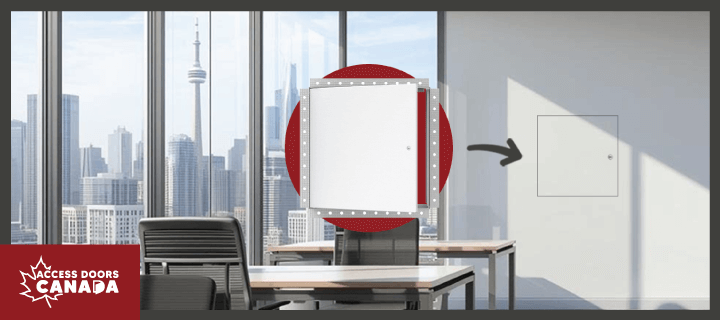
Used in commercial and residential high-rise buildings, the ADC-BAC-FRI Fire-Rated Insulated Access Door provides service access within fire-rated walls and ceilings found in mechanical and electrical rooms, stairwells, service corridors, ceilings, and attic spaces.
Compliance is supported through the following design and performance characteristics:
- Tested fire performance, providing up to a 2-hour fire-resistance rating when installed in approved assemblies
- Heavier-gauge steel construction, including a 16-gauge cold-rolled steel frame and a 20-gauge galvanized steel door panel
- High-temperature mineral wool insulation, contributing to fire-resistance and thermal performance
- Spring-loaded self-latching mechanism, consistent with NFPA 80 requirements for fire door assemblies
- Materials suited for repeated access, supporting long-term performance without degradation
- Recycled-content insulation, which may contribute toward LEED v4 material credits.
Interested in ordering this product? Request a quote today and our team will provide competitive pricing and guidance every step of the way.
When Should Access Panels Be Coordinated to Avoid Inspection Delays on High-Rise Projects?
Access panels should be coordinated during design development and early trade coordination to avoid inspection delays and scheduling issues on high-rise projects.
When access panel decisions are made late, conflicts are more likely, often resulting in failed inspections or field rework. Even compliant products can be rejected if they are not properly aligned with the approved assembly or documented clearly.
To prevent these issues, access panel selection should be finalized before procurement, with coordination between architects, engineers, and trade contractors to confirm assembly types and installation details.
Before purchasing, even when specifying compliant products such as the ADC-BAC-FRI, project teams should verify that the panel meets the required fire-resistance rating, is approved for the intended wall or ceiling construction, and is accurately reflected in drawings and submittals.
Frequently Asked Questions on Canadian-Compliant Access Panels
1. Do access panels installed in fire-rated walls and ceilings need to be fire-rated in Canada?
Yes. Fire-rated access doors in Canada must meet the same fire-resistance standards as the walls or ceilings they are installed in, ensuring the integrity of the rated assembly. Non-tested or non-listed panels are usually prohibited in fire-rated construction.
2. Which Canadian codes regulate access panels in high-rise buildings?
Access panels are regulated primarily by the National Building Code of Canada (NBC), along with applicable provincial and municipal amendments. These codes govern fire separations, fire-resistance ratings, and penetrations within rated assemblies.
3. What documentation is typically required for access panels during inspection?
Inspectors commonly request fire-test listings, product labels, installation details, and confirmation that the panel matches the approved drawings and specifications. Clear documentation helps streamline the inspection process.
4. Are custom-size access panels acceptable in fire-rated assemblies?
Custom-size access panels may be acceptable if the manufacturer’s fire-test listing covers the specified dimensions or allows for size variations within tested limits. Panels outside approved size ranges may not be accepted.
To Sum It Up
Canadian-compliant access panels are a key consideration for architects and contractors working on high-rise construction, where fire-rated inspection requirements demand careful product selection. Having the right product information and documentation in place early helps streamline coordination and inspection review.
At Access Doors Canad, we support construction professionals with access panels that meet Canadian code requirements and integrate reliably into high-rise wall and ceiling assemblies. Our team provides technical guidance and documentation support to help projects move efficiently from specification through inspection.
Call +1-888-327-5471 for product support or specification assistance.


