



What Access Panels Are Best for Transit Stations and Infrastructure Projects in Canada?
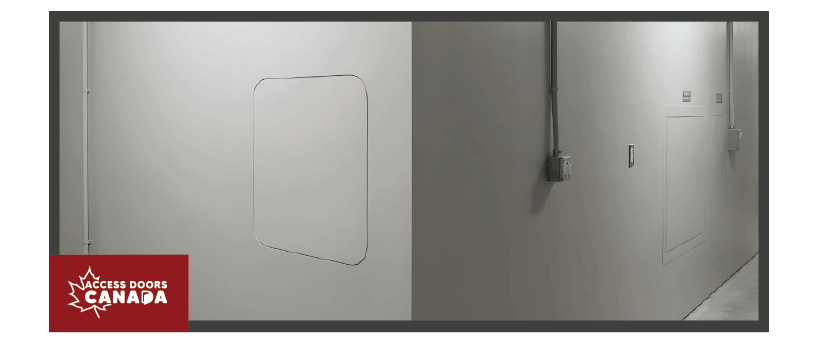
The best access panels for transit stations and infrastructure projects in Canada are heavy-duty steel security doors for service areas and gypsum-based panels that integrate with architectural finishes in public-facing spaces.
Transit facilities face constant foot traffic, vandalism risk, and strict security requirements. Standard, light-duty commercial doors cannot keep up with these demands, which leads to damaged panels and ongoing rework that strain maintenance budgets and disrupt service.
In this article, we’ll look at why transit and infrastructure projects need specialized access panels, when to coordinate them, and how ADC-SLK and ADC-BAC-GRG-RC are well-suited to transit and high-traffic environments.
Why Do Transit Stations and Infrastructure Projects Require Specialized Access Panels?
Transit stations and infrastructure projects require specialized access panels because they operate in high-traffic public environments where security, durability, and inspection access are non-negotiable.
Unlike typical commercial interiors, Canadian transit and infrastructure facilities:
- Operate long hours or 24/7, with continuous use of public areas.
- Face vandalism, tampering, and theft risks around electrical, communications, and fare-control systems.
- Must maintain a safe, accessible environment while enabling regular inspections and repairs.
This means your access points must function as secure access solutions that:
- Protect critical services (power, signalling, data, and mechanical) from unauthorized access.
- Withstand impact, cleaning chemicals, and repeated opening and closing.
- Support inspection readiness so maintenance teams can get in quickly without cutting finished walls and ceilings.
When Should Access Panels Be Coordinated on Canadian Infrastructure Projects to Avoid Rework?
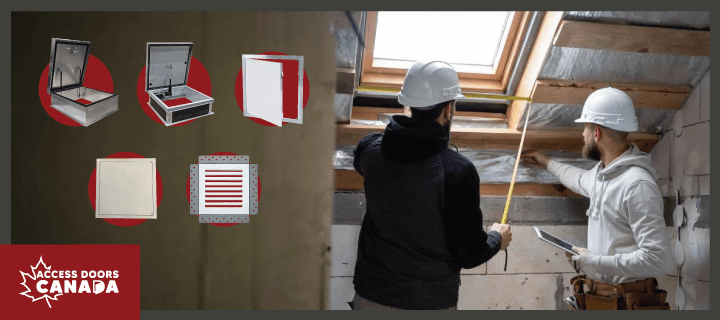
Access panels should be coordinated early in design and during MEP coordination, before drywall and finish packages are locked in.
If you wait until after rough-in or even later in construction, you’ll almost always end up with rework, change orders, and disputes about who pays to add the missing panels.
For commercial access panels in Canada, the best practice is to:
- Identify all required access points at the design development stage, based on equipment, valves, junction boxes, controls, and future maintenance paths.
- Include access panels in architectural and MEP drawings.
- Confirm clearances and swing during coordination, so panels don’t clash with signage, lighting, CCTV cameras, or fare equipment.
- Align the specification with commercial access panel suppliers who can manage large orders, custom sizes, and transit timelines.
Visit our Custom page to learn how our custom access panels can support your transit and infrastructure projects in Canada.
What Durability and Security Factors Matter Most for Transportation Facility Access Solutions?
For public infrastructure access doors, the most important durability and security factors are material strength, tamper resistance, hinge and lock design, corrosion resistance, and lifecycle performance under high traffic.
In high-traffic environments, access doors must:
- Use heavy-gauge steel or other robust materials that resist impact and forced entry attempts.
- Include tamper-resistant locks that can only be opened by authorized personnel.
- Protect hinges and hardware from vandalism by using concealed hinges wherever possible.
- Offer a finish that’s easy to repaint and touch up after maintenance or graffiti removal.
How Do Architectural Finishes and Curved Walls Affect Access Panel Selection?
Architectural finishes and curved wall designs require you to choose access panels that blend seamlessly into the finished surface while still delivering full access to services behind.
In modern Canadian transit stations, ceilings and walls often feature continuous gypsum finishes, curved forms, and integrated lighting and signage. In these spaces, generic framed metal doors can visually disrupt the design.
Instead, you need:
- Gypsum-based inlay panels that tape and finish like drywall for a monolithic appearance.
- Radius corners that follow radius wall construction and curved ceiling planes.
- Smooth, paintable faces that can be colour-matched to surrounding finishes.
- No visible locks or hardware on the face, especially in high-visibility concourses.
How Do ADC-SLK and ADC-BAC-GRG-RC Perform in Transit and Infrastructure Environments?
The ADC-SLK Shur-Lock Access Doors from Elmdor and the ADC-BAC-GRG-RC Pop-Out Radius Corner - Gypsum Access Panel perform incredibly well in transit and infrastructure environments because they address two distinct but complementary needs:
- Robust, secure access in service and back-of-house areas.
- Near-invisible access in highly finished public spaces.
Let’s look at both access panels in detail.
ADC-SLK Shur-Lock Access Door
The ADC-SLK access panel is a heavy-duty, security-focused door designed for high-risk facilities such as schools, hospitals, hotels, and correctional institutions. This makes it a natural fit for secure areas in transit stations and infrastructure sites.
Key performance features include:
- Heavy-gauge construction: A 14-gauge galvannealed steel door panel with a 16-gauge vertical reinforcement channel, set in a 16-gauge galvannealed steel frame, provides excellent impact resistance and long-term rigidity.
- Secure automatic locking: The automatic springbolt lock uses a precision mechanism and a uniquely angled cam that engages as the door closes. You can only remove the key when the lock is in the locked position, reducing the risk of leaving doors unlocked after maintenance.
- Concealed continuous hinge: A concealed continuous stainless steel piano hinge supports repeated opening and closing in high-traffic facilities while keeping hinge points shielded from tampering.
- Versatile installation: The 7/8" flange allows the ADC-SLK to install cleanly in drywall, masonry, or concrete construction. This is ideal for mechanical rooms, electrical rooms, and other service areas behind walls in transit stations, tunnels, and control facilities.
- Finish and optional features: The panel comes with a white prime coat finish that can be painted to match surrounding finishes. For environments with higher corrosion risk or where hygiene and appearance are critical, optional features include:
- Automatic spring door closer
- Stainless steel construction (Type 304, No. 4 satin finish)
ADC-SLK also comes in large sizes up to a rough opening of around 36½" x 36½" that support access to larger equipment, manifolds, and junctions common in transit infrastructure without compromising security.
ADC-BAC-GRG-RC Pop-Out Radius Corner - Gypsum Access Panel
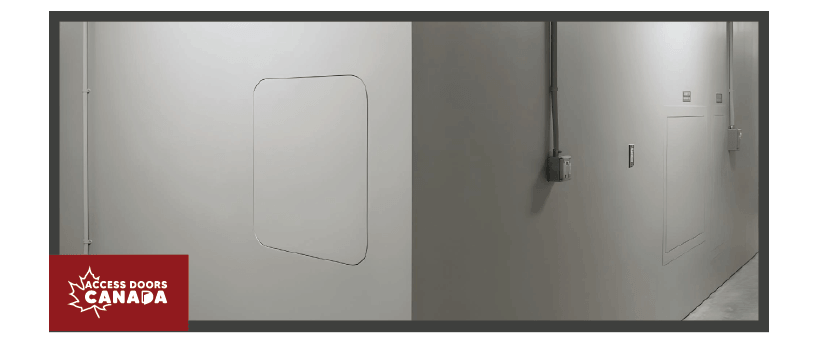
The ADC-BAC-GRG-RC access panel is designed to integrate seamlessly in public-facing spaces, particularly in areas with curved or radius walls and ceilings. It's ideal for locations with public concourse ceilings, feature walls, and curved architectural elements where you want access without visual clutter.
Some of its key features include:
- Glass fibre-reinforced gypsum shell: The panel is made from glass fibre-reinforced gypsum with a shell thickness of 1/8" to 3/16". Fastener pull-out values (approx. 525 lb for wood and 215 lb for metal studs, with a 350 lb push-through average) support secure installation in ceilings and walls.
- Class A, non-combustible face: Tested to ASTM E84, the panel delivers zero flame spread, zero smoke index, and zero fuel contribution, achieving a Class A, non-combustible rating, which is an important consideration in public assemblies like transit stations.
- Architectural wall integration: Tapered edges are designed for tape joints, allowing the drywall trade to tape, mud, and finish the panel perimeter so it blends into the surrounding gypsum. The radius corners help maintain a continuous line in radius wall construction and curved ceiling features.
- Gravity-assisted closing: A gravity-assisted closing mechanism replaces visible locks and exposed hinges, making access simple for maintenance staff while minimizing tampering points and helping the panel sit flush when closed.
- Moisture and mould resistance: The GRG composition and design prevent mould and fungal growth, with no shrinking, cracking, sagging, or rusting. This supports long-term lifecycle performance in busy, conditioned transit interiors.
- Sustainability: The use of glass fibre-reinforced gypsum, often with a high proportion of post-consumer recycled glass content, aligns with green building and sustainability objectives increasingly common in Canadian public infrastructure work.
Request a quote to evaluate ADC-SLK and ADC-BAC-GRG-RC based on your transit or infrastructure project requirements.
Frequently Asked Questions on Infrastructure Access Panels in Canada
1. What is the main purpose of access panels in transit stations?
Access panels provide safe, controlled access to hidden building systems, such as electrical conduits, communications cabling, HVAC, and plumbing, so your maintenance teams can inspect, repair, or replace components without demolishing finished surfaces. In transit environments, they also support security by limiting access to authorized personnel.
2. Do access panels in transit facilities have to be fire-rated?
Whether access panels need to be fire-rated depends on the fire rating of the wall or ceiling assembly they penetrate, as well as the applicable building and fire codes for your project. In rated assemblies, you must use fire-rated access doors tested for that specific application, while non-rated assemblies can use Class A, non-combustible panels, such as gypsum GRG units.
3. Can access panels be customized for curved walls or unique conditions in existing stations?
Yes. Access Doors Canada can provide custom sizes and configurations, including panels designed specifically for curved walls and ceilings or for retrofits where openings don’t match standard dimensions. Models like ADC-BAC-GRG-RC, with radius corners and tapeable edges, are particularly well-suited for integration with complex geometry in modern transit stations.
To Sum It Up
In Canadian transit stations and infrastructure projects, standard light-duty panels often introduce too much operational risk. As a result, you need access panels that can handle round-the-clock use, security risks, and demanding architectural finishes.
The ADC-SLK and ADC-BAC-GRG-RC provide that balance of security, durability, and architectural integration with walls across both service zones and public spaces.
Contact our team or call +1-888-327-5471 to get personalized recommendations tailored to your access strategy. We can help you keep public-facing and service areas protected in the long term.


