



How Do Flush Access Panels Blend with Modern Commercial Interior Design?
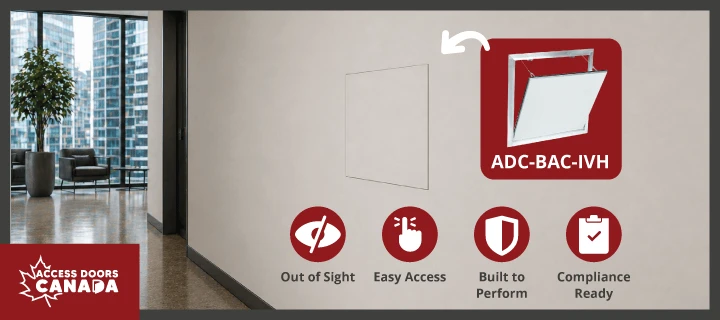
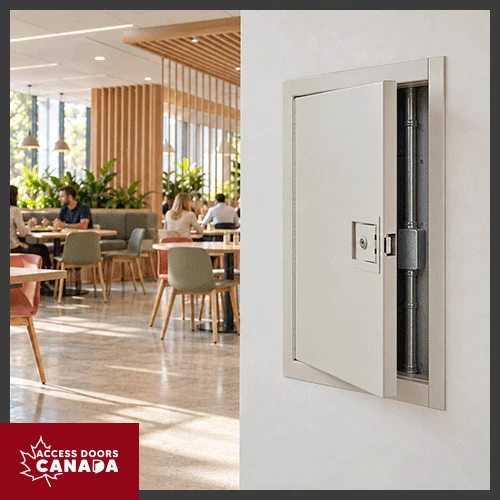
Flush access panels blend with modern commercial interiors by aligning almost level with walls and ceilings. This helps you conceal building services behind these assemblies without breaking clean lines or careful detailing.
Modern commercial interiors in Canada lean heavily on simple forms, clean lines, and clutter-free surfaces. When access points clash with that design, the whole space can feel less intentional and less premium.
In this article, we’ll look at why modern commercial interior access doors matter, how they differ from surface-mounted options, and how ADC-BAC-UAP and ADC-BAC-IVH support clean, modern detailing in Canadian projects.
Why Do Flush Access Panels Matter in Modern Commercial Interior Design?
Flush access door design matters in modern commercial interiors because it lets you meet code and operational requirements without compromising your space's aesthetic design.
On almost every commercial project, you have to conceal mechanical, electrical, plumbing, and life-safety systems behind walls and ceilings. Canadian building codes require that these systems be installed with provision for safe access for inspection, maintenance, repair, and cleaning.
If you don’t plan that access carefully, you might lose finish protection and end up with:
- Random access doors in highly visible areas.
- Improvised openings being cut after finishes are complete.
- Ongoing patching that never fully blends back in.
Flush access panels reduce those issues because:
- The door face is nearly even with the surrounding surface.
- The frame can be expressed as a neat, narrow reveal or a clean exposed flange.
- Once painted or finished, the door reads as a controlled part of the wall or ceiling rather than a bolt-on accessory.
Explore our flush access panel options to find the perfect fit for your design intent. You can also request a quote for our custom access solutions if you’re working with unique wall or ceiling conditions.
How Do Flush Access Panels Differ from Surface-Mounted Options?
Flush-mounted detailing differs from surface-mounted options in how access panels sit on the surface, how they look, and how easily they integrate with surrounding finishes.
A flush access door is designed so that the face is nearly even with the surrounding surface. The flange is recessed or expressed as a slim reveal, and once painted, the panel is visible up close but doesn’t stand out from a distance.
A surface-mounted access door, on the other hand, sits on top of the finished surface. Frames and hardware project into the space, and the panel looks like something that was added on afterward.
When Should Flush Access Panels Be Specified to Avoid Finish Issues?
You should specify flush access panels early (ideally during design development and coordination) so that access points are part of the interior concept rather than an afterthought.
If access is left until late in the process, you’re more likely to:
- Cut openings through finished walls or ceilings.
- Misalign doors with lighting, sprinklers, or feature elements.
- Accept door sizes or locations that are awkward to use.
To avoid that, build access decisions into three key stages:
- Before you finalize the ceiling and wall layouts.
- Before you lock in interior assemblies.
- Before you issue tender drawings.
What Coordination Steps Ensure Flush Panels Blend with Finished Interiors?
Flush access panels blend with finished interiors when you plan their locations, details, and installation sequence alongside your walls and ceilings, so they align with the overall finish layout.
Here are four steps your team can follow to ensure your access panels blend with finished interiors:
1. Coordinate Locations with Services and Sightlines
Work with your mechanical, electrical, and plumbing consultants to map out all required access points.
Once you know where access is needed, place panels in locations that make sense for both serviceability and visual order. For example, aligning them along a corridor line or within regular ceiling bays instead of scattering them across multiple walls.
2. Protect Finishes Through Detailing
Once you set the locations, the next step is to protect your finishes through clear detailing. Show framing, blocking, and joint treatments in your drawings so drywall and ceiling trades understand exactly how to build around each panel.
Also, use consistent reveals, flange widths, and joint patterns across the project so your access doors read as part of a deliberate design system rather than a series of one-off solutions.
3. Align with Energy and Code Requirements
Canada’s National Energy Code for Buildings (NECB) 2020 places greater emphasis on building envelope performance and air leakage.
With that in mind, confirm with your design team whether any access locations intersect walls or ceilings that also form part of the building envelope. This way, you can make sure joints between panels and surrounding assemblies are sealed appropriately for the space.
4. Plan Installation Sequencing
Planning installation sequencing allows you to integrate access doors cleanly without unnecessary rework.
For universal flush panels, coordinate when openings will be framed, when the panel itself will be installed, and when final painting will occur, so each trade knows where their work starts and ends.
For drywall inlay systems, decide whether panels will be installed and finished as part of the main drywall work or set later with carefully managed joint treatment.
How Do ADC-BAC-UAP and ADC-BAC-IVH Support Clean, Modern Detailing?
The ADC-BAC-UAP Flush Universal Access Door with Exposed Flange and the ADC-BAC-IVH Invisa Hatch™ Drywall Inlay with Fully Detachable Hatch support clean, modern detailing by giving you two flush access solutions that either sit neatly within the wall or ceiling plane or become almost invisible once finished.
Let’s look at each access panel in detail.
ADC-BAC-UAP Flush Universal Access Door with Exposed Flange
The ADC-BAC-UAP access panel is designed for non-rated masonry and gypsum drywall ceilings and walls. It offers a straightforward way to standardize flush access points across multiple spaces and projects.
Key characteristics include:
- 16-gauge cold-rolled steel construction for a durable, commercial-grade door and frame assembly.
- Hidden pin hinge, with a continuous piano hinge on doors over 24" in height or width, to support smooth operation and long-term performance.
- 1" exposed flange that simplifies installation and creates a clean, consistent border around the opening.
- High-quality white powder coat primer, ready for painting or texturing, so you can blend the panel with surrounding finishes.
- Standard screwdriver-operated cam latch, with optional key-operated cylinder cam latches, hex head latches (including pinned options), and handle-operated latches where you need controlled access.
- Optional stainless steel 304 (#4 brushed finish) and neoprene gasketing for locations exposed to moisture or higher wear.
ADC-BAC-IVH: Invisa Hatch™ Drywall Inlay with Fully Detachable Hatch
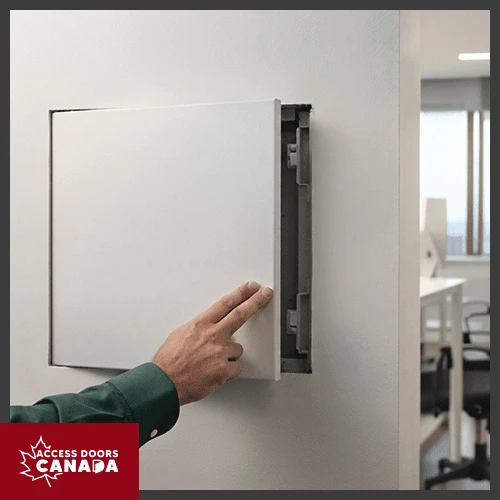
The ADC-BAC-IVH access panel is designed for high-end interiors, like executive suites, galleries, and other design-forward spaces, where you want concealed service access points to be almost invisible once finished.
Its design combines:
- A welded aluminum outer and inner frame, manufactured from high-grade aluminum for strength and longevity.
- Factory-installed 1/2" or 5/8" inlayed drywall, so the panel can be taped, sanded, and painted along with the surrounding surface.
- A slim 1/16" reveal between the frame and door, which is all that remains visible after finishing.
- Concealed snap locks that open when pressure is applied to the spring-loaded latch side, eliminating visible hardware on the face.
- A fully detachable hatch that can be removed when you need full access and reattached without compromising the surrounding finishes.
- A safety system for sizes 12" x 12" and up to prevent accidental openings, which must be reattached if the hatch is removed.
- A perimeter seal to help maintain a clear separation between spaces.
- Hardware options include screwdriver-operated cam latches, four-square cam latches, round cylinder locks with keys, mortise cylinder preparation, and hex head latches.
Ready to align your access detailing with modern interior finishes? Request a quote for ADC-BAC-UAP and ADC-BAC-IVH to discuss how these panels can support your next commercial interior fit-outs.
Frequently Asked Questions on Commercial Interior Access Doors
1. How do you make access panels less noticeable in modern interiors?
You can make access panels less noticeable by choosing flush or drywall inlay models, aligning them with other ceiling and wall elements, and finishing them to match surrounding surfaces.
2. Are flush access panels suitable everywhere?
Flush access panels, like ADC-BAC-UAP and ADC-BAC-IVH, are designed for non-rated masonry and drywall interiors. Where walls or ceilings also serve as fire separations or part of the building envelope, you may need rated or specialty doors to satisfy the applicable building and energy codes.
3. Do flush access panels affect airtightness or acoustic performance?
Any opening in a wall or ceiling can affect airtightness and sound transfer if it’s not detailed and sealed correctly. Using panels with perimeter seals (like ADC-BAC-IVH) and ensuring edges are properly sealed or gasketed where required can help maintain the intended performance of partitions and ceilings.
To Sum It Up
Concealed access panels in Canada provide a reliable way to meet code-required access, maintenance, and operational requirements without undermining modern commercial interior design.
When you choose models such as ADC-BAC-UAP and ADC-BAC-IVH and specify them early enough, you can maintain clean sightlines, reduce rework, and support lifecycle maintenance access across your projects.
Contact our team or call +1-888-327-5471 if you’re planning a modern commercial interior and want access solutions that align with your design and operational expectations.


