



What Contractors Need to Know About Access Panel Compliance Across Canadian Provinces
Access panel compliance in Canada goes beyond picking a rated access door. The project must ensure compliance across four regulatory tiers: the National Building Code of Canada (NBC), provincial modifications, local AHJ enforcement expectations, and project-level inspection documentation standards.
While the NBC provides a standardized foundation, the reality of multi-province construction standards is that each region faces different building challenges. A panel approved in New Brunswick may face different installation or documentation hurdles in British Columbia.
To remain compliant, contractors must ensure that every opening meets these unique administrative requirements. Misalignment results in failed final inspections, costly retrofits, and pushed occupancy dates.
Navigating these differences is the primary pain point for firms managing national portfolios.
In this post, we’ll explain the nuances of Canadian building code for access panels, helping you move from the design phase to the final walkthrough without compliance friction.
How Does Access Panel Compliance Differ across Canadian Provinces?
Access panel compliance differs across Canada because provinces have the constitutional authority to amend, adopt, or override specific technical requirements. Each province has distinct administrative rules and technical requirements that affect how on-site construction compliance is checked.
For instance, the Ontario Building Code (OBC) places strong emphasis on energy compliance under SB-10. In envelope assemblies, insulated and gasketed access panels may be required to maintain air barrier continuity. As a result, documentation and installation details are often reviewed closely.
The British Columbia Building Code (BCBC), on the other hand, incorporates heightened seismic requirements. In practice, that can influence how fire-rated access panels are anchored, sealed, and evaluated during inspection.
In addition, the authority having jurisdiction (AHJ) in a major city like Vancouver may require more detailed testing information than an inspector in a smaller municipality.
The Role of the National Building Code of Canada
The National Building Code of Canada (NBC) acts as the baseline for access panel compliance. It requires that any opening created in a fire-rated assembly, whether for plumbing, HVAC, or electrical access, be protected by a closure that maintains the assembly's fire rating.
If you're cutting into a 2-hour fire separation, the NBC requires an access panel tested and listed to perform under those specific conditions. It is the standard that ensures fire-rated assemblies remain intact.
Provincial Amendments and Local Interpretation
The transition from national to local reality happens at the provincial level. Ontario, for example, operates under its own building code, which, while heavily based on the NBC, includes specific nuances regarding high-rise requirements.
Understanding Canadian building code access panels requires looking at the General Provisions of the specific province. Check if they have heightened requirements for smoke seals or self-closing mechanisms beyond the national standards.
Inspection Enforcement Differences
Enforcement culture varies significantly from one region to another. In some jurisdictions, an inspector may be satisfied with seeing a ULC or Intertek label on the inside of the door.
In others, particularly in high-density commercial zones, you may be required to provide a full submittal package, including the manufacturer's original testing reports.
This variation in multi-province construction standards means contractors must be over-prepared with documentation to avoid delays in stricter regions.
Tired of juggling different specs for every province? Ensure your project is code-ready from day one with our full range of ULC-listed access solutions. Whether you are working in BC or Ontario, we provide the fire-rated access panels you need to maintain the rating of any assembly.
Why Are Fire-Rated Access Panels Closely Scrutinized During Inspections?
Fire-rated access panels are closely scrutinized because they represent a deliberate weak point in a building's rated infrastructure.
Maintaining Assembly Integrity
Commercial fire separation in Canada relies on the ability to slow down fire and smoke within a specific zone.
An access panel is not a standalone item; it is a component of a larger system. Inspectors verify that the fire-rated assemblies are not "voided" by the installation. If an access panel is improperly rated, incorrectly installed, or modified in the field, the integrity of the entire wall or ceiling assembly is compromised.
Therefore, if a contractor installs a non-rated panel into a fire-rated shaft wall, the inspector can fail that portion of the work. The goal of the inspection is to ensure contractors apply the engineers' compartmentalization strategy during the physical build.
Common Inspection Failures
- Painted-Over Labels: This is a common failure, but it's easy to avoid by choosing a panel with a label placed on the back of the door leaf. If an inspector cannot read the UL/ULC or Intertek label because it was covered during the finishing stage, the panel often gets rejected.
- Improper Frame Anchoring: A fire access door is only as good as its connection to the studs. Inspectors verify that the anchoring complies with the manufacturer's specific instructions.
- Field Modifications: Cutting, drilling, or adding unapproved hardware to a fire-rated access panel usually voids its listing.
What Documentation Should Contractors Prepare for Cross-Province Projects?
Contractors should prepare the manufacturer's listing certificate, product data sheets, and specific installation instructions. When working across borders, provincial construction compliance requires maintaining a physical trail of documentation.
At the point of inspection, have the AHJ approval documentation ready. This includes:
- Drawings that were approved during the submittal phase
- Specific fire-test standards the panel was tested against (such as CAN/ULC-S104).
- Manufacturer's proof of rating, especially in provinces with rigorous inspection-readiness protocols, such as Quebec or BC.
Related: How To Choose Access Doors That Meet Provincial Building Codes
How Does ADC-BAC-FRI Help Maintain Compliance in Varied Jurisdictions?
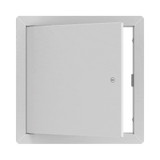
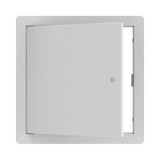
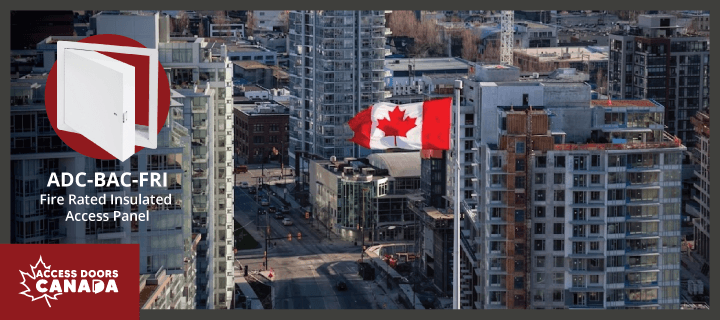
The ADC-BAC-FRI Fire-Rated Insulated Access Panel simplifies compliance across provinces as it's pre-certified and built to meet NBC requirements. It supports multi-province construction standards through these specific features:
- Fire Rating Compliance: It complies with NBC requirements for self-latching and self-locking mechanisms. It's also certified to CAN/ULC fire test standards, satisfying the documentation verification needs of local inspectors across provinces.
- Universal Fire Rating: The 2-hour fire rating and 2" mineral wool insulation withstands temperatures over 2,000°F. This panel maintains the integrity of high-traffic fire-rated assemblies, such as stairwells and mechanical rooms.
- Robust Material Standards: It's constructed from 16-gauge cold-rolled steel and a 20-gauge galvanized door. It meets the structural durability expectations of Canadian commercial fire separation
- LEED v4 & Eco-Friendly Compliance: For projects in jurisdictions with strict sustainability bylaws, the ADC-BAC-FRI contributes to LEED credits by using recycled material in its insulation, reducing the project's carbon footprint.
- Seamless Aesthetic Integration: The 2 ½-inch frame is thicker than standard models. This allows it to cover rough openings and provide a polished finish that passes aesthetic and technical audits.
A failed inspection costs more than a quality access door. Don't let a "paint-over" disaster or a missing label lead to a costly deficiency report. Request a quote for the ADC-BAC-FRI to ensure compliance and guarantee inspection readiness for your most critical fire-rated assemblies.
FAQs about Access Panel Compliance in Canada
1. Is a 1.5-hour B-Label enough for a 2-hour shaft wall in Ontario?
Usually, no. In most Ontario commercial applications, the closure's fire rating must match the assembly's rating. Installing a 1.5-hour panel in a 2-hour shaft is a leading cause of a deficiency report. To pass inspection the first time, always match the door's hourly rating.
2. Can I use this in a horizontal (ceiling) application, or is it wall-only?
It depends on the specific listing. Fire behaves differently in ceilings, so you must use a panel explicitly rated for horizontal installation. The ADC-BAC-FRI is versatile and certified for both walls and ceilings, ensuring the assembly maintains its rating regardless of orientation.
3. Where is the physical ULC label located? I need to show the inspector.
The physical label is typically found on the inside of the door leaf or the inner frame. Prevent a "paint-over" disaster by masking this label during finishing. If an inspector cannot read the rating, the door will likely fail the inspection.
4. Do I need an insulated panel for a partition without a temperature-rise requirement?
While not always legally mandated for every interior wall, using an insulated panel is a best practice for multi-province construction standards. It offers superior fire protection and acoustic dampening, often satisfying a strict AHJ who may have concerns about heat transfer, even if the code is ambiguous.
Conclusion
Navigating access panel compliance in Canada doesn't have to be a jurisdictional headache. The National Building Code is only the starting point, and provincial compliance requires local attention. Understanding this helps contractors proactively manage risk.
Successful inspection lies in three areas: selecting the right fire-rated access panels, maintaining impeccable documentation verification, and ensuring that every installation respects the integrity of the commercial fire separation.
Using standardized, high-performance solutions like the ADC-BAC-FRI streamlines your operations across borders. It gives you confidence that your project will meet the mark in Vancouver, Toronto, or Halifax alike.
Stop guessing on provincial amendments and AHJ interpretation. If you need help verifying that a specific access panel meets the NBC for your region, our team is here to help. Message us or call +1-888-327-5471 today to ensure your next walkthrough is deficiency-free.


