



Why Airtight & Watertight Access Panels Are Essential for High-Performance Commercial Builds
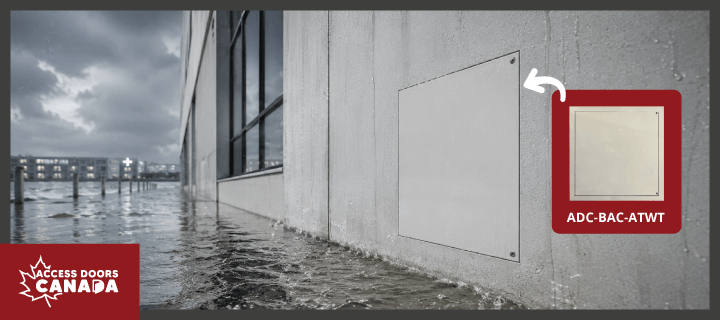
Airtight and watertight access panels are essential in high-performance commercial buildings because they maintain the continuity of the air and water control layers at service openings.
When you treat these panels as part of the air barrier and moisture-management system, you reduce leakage, protect assemblies from degradation, and support energy and lifecycle durability targets.
In this article, we’ll look at why access panels matter for envelope performance, the risks of poorly sealed openings, and what defines a true airtight and watertight panel. We’ll then discuss how the ADC-BAC-ATWT access panel model supports high-performance commercial construction.
Why Are Access Panels Critical to Airtight and Watertight Building Envelopes?
Access panels are critical to airtight and watertight building envelopes because each panel creates an opening in the air and water barriers, and you have to carefully rebuild the seal around the door to prevent air leakage, water intrusion, or comfort issues.
Access doors are especially sensitive because they:
- Penetrate walls and ceilings precisely where air and water barriers need continuity.
- Are often added or adjusted late in design or during fit-out, when envelope details are already set.
- Must remain operable for the life of the building, so the seal has to work through repeated use and maintenance cycles.
If you don’t specify airtight access panels for air barrier locations, you might end up with carefully detailed membranes and tapes compromised by a door that leaks around its frame or through the leaf.
Over the life of the building, those small openings can compromise air barrier continuity, water infiltration control, and thermal envelope integrity.
Explore our airtight and watertight access door options to learn how these panels can support high-performance commercial buildings in Canada.
What Risks Do Poorly Sealed Access Openings Create in Commercial Builds?
Poorly sealed access openings are risky because they allow air and water to leak through small gaps in the building envelope.
Leaky access doors can increase air leakage to the point where a building no longer meets its energy performance targets. Studies show that air leakage can account for up to 25% of space heating energy use and up to 40% of peak heating load when not properly controlled.
In a high-performance or net-zero energy-ready design, that margin is often the difference between hitting or missing code or incentive thresholds.
On the moisture and durability side, poorly sealed access points can:
- Channel wind-driven rain behind cladding or into insulated cavities, increasing the risk of corrosion, mould, and finish damage over time.
- Accelerate freeze–thaw exposure by allowing trapped moisture to cycle around frames and fasteners in cold climates.
- Create condensation points when warm, moist interior air exfiltrates through gaps and hits cold surfaces near the opening.
For inspections and occupancy, leaky access doors can also cause issues such as:
- Failed blower-door or compartmentalization tests, where targeted air-leakage rates aren’t met because of obvious leaks at access openings.
- Delayed occupancy or commissioning when envelope performance doesn’t align with NECB pathways or project energy models.
- Higher maintenance and lifecycle costs as facility teams chase recurring leaks, interior damage, or comfort complaints around these openings rather than focusing on core systems.
What Features Define an Airtight and Watertight Access Panel?
An airtight and watertight access panel is defined by its ability to keep air and water from passing through the opening under normal service conditions, while still allowing safe, repeatable access for maintenance.
In general, you should look for panels that combine:
- Robust construction: A solid frame and door that resists bending, warping, and damage so the seal stays tight over time, even with frequent use or pressure differences across the assembly.
- Continuous gasketing: A continuous gasket around the opening made from durable material can maintain compression and elasticity through temperature swings, cleaning, and regular operation.
- Well-detailed joints and corners: Frames and doors should be joined and finished so there are no obvious gaps, openings, or weak points where air or water can bypass the main seal.
- Reliable hinges and hardware: Hinges and latching keep the door aligned, pull it evenly against the gasket, and support smooth opening and closing without loosening the seal over time.
- Envelope-ready finishes: Corrosion-resistant finishes that suit the intended environment, whether a standard commercial space or a demanding healthcare, laboratory, or industrial setting, can help the panel maintain its seal and appearance over the long term.
- Documented performance testing: Verified performance against recognized air and water leakage tests will help you avoid relying on assumptions.
Related: What Airtight Access Panels Support Building Envelope Performance?
How Does ADC-BAC-ATWT Support High-Performance Commercial Construction?
The ADC-BAC-ATWT Airtight & Watertight Flush Access Door supports high-performance commercial construction by combining robust construction, proven sealing performance, and an envelope-ready profile that integrates smoothly with your overall building envelope strategy.
To deliver that level of performance, ADC-BAC-ATWT is built as a heavy-duty, flush access panel for walls and ceilings, designed to prevent both air infiltration and water penetration.
The model uses:
- A 16-gauge steel frame and door, with a 1.5" trim and continuously welded joints for stability and airtightness.
- EPDM co-extruded trim-seal gasketing between door and frame with a clamping range of 0.040"–0.118" to provide reliable compression at typical tolerances.
- A continuous piano hinge to maintain alignment and seal contact through repeated opening and closing.
- Stainless steel pan head Phillips screws with self-retaining washers to help installers achieve consistent bearing and gasket compression.
- A prime coat rust-inhibitive electrostatic powder finish baked white enamel as standard, with stainless steel No. 4 finish available where required.
On the performance side, ADC-BAC-ATWT is independently tested for air and water resistance. When installed according to the manufacturer’s instructions, it achieves air infiltration rates of less than 0.1 L/s/m² (<0.01 cfm/ft²) in ASTM E283/E283M testing and passes water penetration resistance testing per ASTM E331.
Request a quote for ADC-BAC-ATWT to learn more about how this model can meet your project’s air and water control requirements.
Frequently Asked Questions on Weather-Resistant Access Doors
1. When should airtight and watertight access panels be specified to avoid envelope failures?
You should specify airtight and watertight access panels as soon as you define your air and water control strategy. This could be during schematic design and early envelope detailing.
At that point, you already know where shafts, risers, mechanical rooms, and sensitive spaces will be located, so you can plan access points that support the envelope rather than cutting into it later.
2. Can airtight access panels in Canada be retrofitted into existing walls and ceilings?
Yes, airtight and watertight access panels, like ADC-BAC-ATWT, can be retrofitted into existing walls and ceilings, but they must be integrated carefully with the existing air and moisture barriers.
For the best results, identify the location of the existing air barrier (e.g., sheathing membrane or interior gypsum) and plan how the new frame will tie into it. Then, provide appropriate backing and framing so that the panel can be fastened without crushing insulation or leaving voids.
This approach will allow you to improve access to the commercial building envelope without sacrificing airtightness or moisture performance.
3. Are airtight and watertight access panels required by Canadian codes?
Canadian building and energy codes generally don’t specify specific access panel models. Still, they do require the overall wall or roof assembly to meet performance targets for air leakage, moisture management, and, in some cases, energy efficiency.
This means that if an access opening falls within an air barrier or a weather-exposed assembly, the panel you choose must meet those performance requirements.
To Sum It Up
Airtight and watertight access panels are integral components of the air and water control strategy in high-performance commercial buildings.
By treating access points as part of the building envelope, you can preserve the air barrier continuity, reduce water infiltration risks, and support the energy and durability outcomes demanded by modern Canadian codes and climate commitments.
Contact our team or call +1-888-327-5471 to coordinate envelope-ready access panel solutions for your next commercial build. Our team will help you align gasketed access panels in Canada with your energy, durability, and inspection readiness goals.


