



Top 3 Drywall Access Panels Contractors Use for Repeat Installs in High-Rise Projects
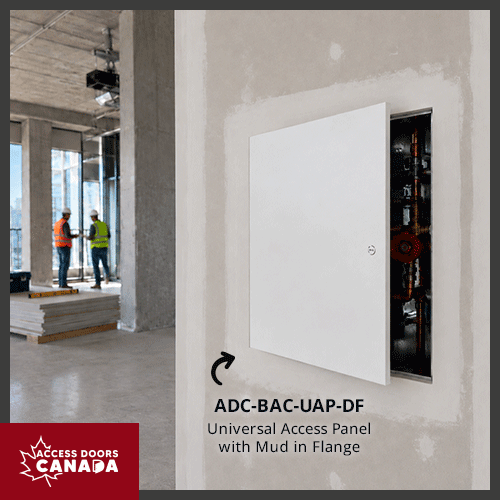
The three drywall access panels commercial contractors use for repeat high-rise installs are the ADC-BAC-UAP-DF flush universal access door with mud in flange, ADC-BAC-RAD-DF recessed access panel with drywall bead flange, and ADC-BAC-EZMAG adjustable magnetic closing access panel.
Contractors often select these panels because they can install them consistently across floors, finish them without extra wall work, and order them reliably in bulk.
In this article, we'll cover why access panel consistency is crucial in high-rise drywall installation and which high-rise access panels commercial contractors rely on for repeat installs.
Why Does Access Panel Consistency Matter in High-Rise Drywall Installations?
Access panel consistency matters in high-rise drywall installations because the panel specs you set on one floor are often replicated on every floor above it. As a result, any inconsistency in fit, finishing, or lead times can affect schedules, inspection readiness, and labour coordination.
Commercial drywall contractors already work within compressed timelines. If one access panel requires extra mudding adjustments while another sits unevenly within the wall assembly, finishing crews could lose time correcting preventable issues. This delay would eventually affect painters, MEP trades, and final inspections.
However, when you standardize your high-rise access panel specification, you eliminate that friction point across the entire project.
As a result, you gain:
- Predictable rough opening requirements on every floor, so framing crews aren't making adjustments mid-project.
- Consistent finish quality that meets inspection standards without additional wall work.
- Simplified bulk access panel purchasing with stable lead times and no mid-project substitutions.
- Faster installation because your crews know the product before they reach the next floor.
Looking for contractor-grade drywall access panels built for commercial and high-rise installs? Explore our full lineup of commercial drywall access solutions to get the specs right from the start.
What Are the Top Drywall Access Panels Contractors Use for Repeat High-Rise Installations?
As mentioned, the top commercial drywall access solutions that contractors use for repeat high-rise installations include:
- ADC-BAC-UAP-DF Flush Universal Access Door with Mud in Flange
- ADC-BAC-RAD-DF Recessed Access Panel with Drywall Bead Flange
- ADC-BAC-EZMAG Adjustable Magnetic Closing Access Panel
These access panels are suitable for repeat installations because they prioritize clean finishes, adaptable installation, and long-term reliability without requiring product swaps or mid-project workarounds.
Let’s look at each access panel in detail.
1. ADC-BAC-UAP-DF Flush Universal Access Door with Mud in Flange
The ADC-BAC-UAP-DF access panel is a flush-mounted universal panel designed for non-rated masonry and gypsum drywall applications, covering both wall and ceiling installations.
Here’s what makes it work across repeat installs:
- Perforated mud-in flange: The drywall corner bead flange accepts tape and joint compound. As a result, your finishing crew can run the same process they use on every other drywall seam.
- 16-gauge cold rolled steel construction: Reliable in moisture-prone mechanical and plumbing access areas without rusting or degrading over the building's lifecycle.
- Flush-mounted profile: Installs level with the surrounding drywall surface, eliminating the surface irregularities that trigger finish-grade disputes.
- LEED v4 certified: Supports your project's sustainability documentation without any added specification complexity.
- Customizable latch options: The standard screwdriver-operated cam latch comes as the default. For floors or zones requiring restricted access, you can specify a key-operated cylinder cam latch, hex head cam latch, pinned hex head cam latch, handle-operated cam latch, or mortise preparation for cylinder.
2. ADC-BAC-RAD-DF Recessed Access Panel with Drywall Bead Flange
The ADC-BAC-RAD-DF access panel is designed for projects where concealed appearance and finish integration are priorities. Its recessed configuration allows drywall, acoustic materials, or tile finishes to sit inside the panel opening for a clean visual.
Key specifications include:
- 16-gauge cold rolled steel frame: Heavy enough to withstand repeated access in high-traffic utility zones without warping or loosening at the frame over time.
- 22-gauge galvanized steel, with 2¾" drywall bead flange: Wide enough to bridge framing tolerances cleanly. The bead profile also accepts tape and compounds the same way standard corner bead does, so your finishing crew doesn't need to change technique.
- Continuous piano hinge running the full height of the door: Distributes load evenly across the door edge, which prevents sagging and misalignment on larger panel sizes after repeated openings.
- Allen hex head cam latch: Requires a standard Allen key, which limits incidental access without needing a full lock cylinder. Key-operated cylinder cam latch is available for zones requiring controlled access.
- 5/8" standard, with a special 3" frame option offering 13/16" to 1½" recess:The standard 5/8" recess matches typical drywall and ceramic tile thickness, so the finished surface sits flush. The special option accommodates thicker tile assemblies or acoustic panels without additional shimming.
- Frame depth of 1 5/8": The frame is within standard stud wall depth, so it doesn’t require additional framing modifications.
- High-quality white powder coat primer: Paint-ready straight out of the box. No additional priming required before applying the finish coat.
- LEED ready: Contributes to LEED v4 credits, which supports sustainability documentation on projects where certification is a requirement.
3. ADC-BAC-EZMAG EZMAG™ Adjustable Magnetic Closing Access Panel
The ADC-BAC-EZMAG access panel is built for speed, adaptability, and simplified maintenance access. Its adjustable magnetic design helps contractors reduce installation time while maintaining a clean finished appearance across drywall and ceiling applications.
Here’s why it performs well on repeat installs:
- Adjustable frame: The 24-gauge galvanized steel frame adjusts in 3/8" increments, accommodating openings from 6.5"×6.5" up to 15.5"×15.5". This means one SKU can cover the full range of opening sizes without reorders or on-site modifications on high-rise projects where rough opening placement varies from floor to floor.
- Tool-free magnetic closure: Four concealed magnets (one per polymer corner) hold the door closed and release on demand.
- No hinge or latch: Fewer mechanical components mean fewer failure points over the building's lifecycle. The two included security cables prevent accidental removal while still allowing the door to pop off and back on in seconds.
- 20-gauge cold rolled steel door with beveled edges: The beveled edges give the door a clean, finished look that sits flush against the wall surface. The 20-gauge steel is light enough for tool-free handling but rigid enough to hold its shape and resist denting in high-traffic areas.
- LEED v4 compliant: Supports sustainability documentation on projects where LEED certification is a requirement.
Need bulk pricing or a standardized project specification for your high-rise build? Request a quote for bulk drywall access panel. You can also explore our custom sizing options for project-specific wall and ceiling access requirements.
Frequently Asked Questions on Drywall Access Panels
1. How does access panel standardization improve procurement and installation efficiency?
Standardizing drywall access panels improves procurement and installation efficiency by reducing product variation across the project. When contractors repeatedly install the same panel model, crews become more efficient, procurement teams simplify ordering, and finish quality becomes more predictable.
This reduces:
- Training and installation inconsistencies
- Ordering errors
- Lead-time variability
- Finish correction work
- Coordination delays between trades
2. What is the benefit of a mud-in flange access panel in commercial drywall applications?
A mud-in flange access panel helps create a cleaner finished appearance by allowing drywall compound and tape to integrate directly around the panel perimeter. This reduces visible transitions between the panel and the surrounding drywall assembly.
3. Why are magnetic access panels becoming more common in commercial projects?
Magnetic access panels are becoming more common in commercial projects because they simplify installation and improve maintenance accessibility. Panels, like the ADC-BAC-EZMAG, eliminate hinges and visible latching hardware, allowing faster access while maintaining a cleaner appearance.
To Sum It Up
The best drywall access panels for high-rise projects are those that support repeatability, finish consistency, and efficient floor-to-floor installation.
Panels like the ADC-BAC-UAP-DF, ADC-BAC-RAD-DF, and ADC-BAC-EZMAG allow contractors to standardize installations across large commercial developments. This helps them reduce procurement variability and minimize finish-related rework.
Contact us or call +1-888-327-5471 to confirm specifications and product availability for your next high-rise project.


