



Access Panel Finishes: Mud-In, Hidden-Flange, or Surface-Mount
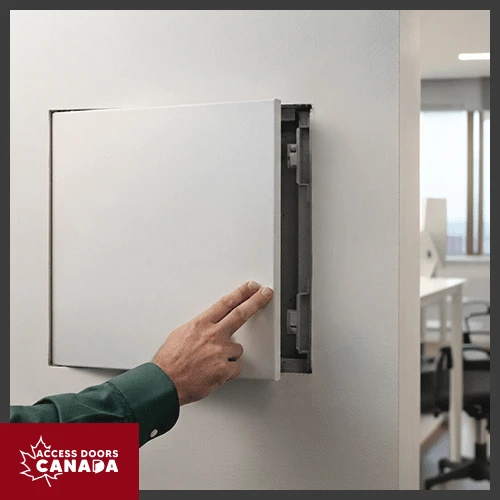
Mud-in panels suit drywall applications where a seamless finish is the priority. Hidden-flange panels reduce visible framing while keeping the door identifiable, while surface-mount panels prioritize straightforward installation over concealment.
Choosing the wrong access panel finish may not cause problems on day one. It shows up weeks later, when a painter is fighting a visible frame lip, or a technician cannot find a concealed access panel that was mudded flush in a space where nobody needed it hidden.
If you are sourcing access doors in Canada for an upcoming project, understanding these finishes up front saves coordination bumps later.
This guide breaks down the three most common access panel finishes in Canadian commercial construction. It discusses the problem each frame solves and what to consider during selection.
What Are Access Panel Finishes, and Why Do They Matter?
Access panel finishes describe how the frame interacts with the surrounding wall or ceiling, as opposed to the door colour or coating. That distinction determines whether you end up with a concealed access panel or an exposed unit, and how much labour coordination the job requires.
For contractors, this affects on-site sequencing. For architects and specifiers, it affects the finished look and long-term service access. Getting your access panel finished right early can help you avoid rework once drywall and paint crews are gone.
Not sure which frame style fits your application? Browse our full range of access doors for any surface and compare options for different substrates and finish requirements.
What Is a Mud-In Access Panel?
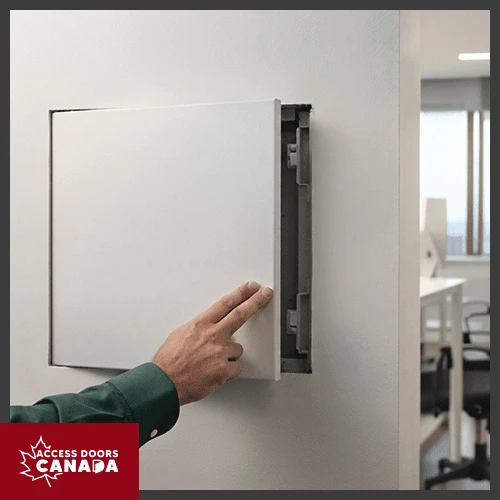
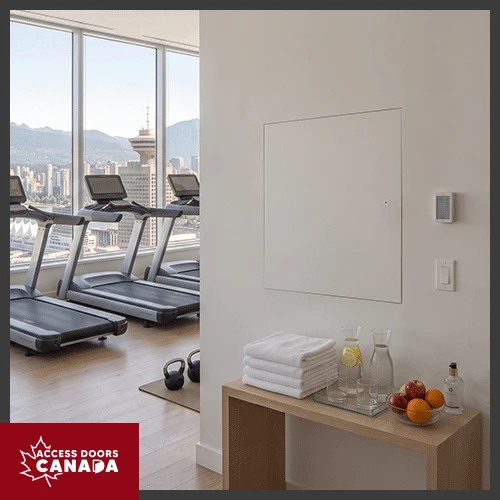
A mud-in access panel uses a beaded drywall flange that gets taped and mudded flush with the wall, so the frame disappears once painted. It is a reliable choice when a drywall access panel needs to blend seamlessly into a finished, visible surface.
The bead accepts joint compound the same way drywall corner bead does, leaving no visible metal edge, just a paintable seam. Because of this, a mud-in access panel needs to be planned into the finishing schedule rather than added afterward:
- Requires coordination with drywall and painting trades
- Best installed before final finishing, not after
- Adds a finishing step, so timing matters
- Well-suited to non-rated drywall in visible areas
That coordination requirement is why mud-in panels are specified early. Other surface conditions, including tile, plaster, and masonry, introduce different installation and finish requirements.
Related: Top 3 Drywall Access Panels Contractors Use for Repeat Installs in High-Rise Projects
What Is a Hidden-Flange Access Panel?
A hidden-flange access panel conceals its frame behind the finished surface, letting tile, plaster, or masonry run right up to the opening without a visible lip. It achieves a similarly seamless, concealed-access-panel look through a different mechanism suited to different materials.
Where a mud-in access panel relies on joint compound, a hidden-flange access panel relies on the finish material wrapping to the opening. Common applications include:
- Tiled bathroom and shower walls
- Plaster or stucco finishes
- Feature walls that need a continuous appearance
- Substrates where a mud-in bead is not compatible
However, not every application calls for that level of concealment. In back-of-house and utility areas, a visible frame is often not a drawback at all. This is where surface-mount access panels become appropriate.
What Is a Surface-Mount Access Panel?
A surface-mount access panel sits on top of the finished wall, with a visible frame and no drywall integration required. It is a fast, low-labour option, which matters when schedule and budget take priority over concealment.
Because it skips the finishing sequence, a surface-mount access panel can be installed after the walls are already painted, making it common for retrofit work. It tends to make sense in:
- Mechanical rooms and utility corridors
- Data centres and back-of-house areas
- Frequent-access locations where speed matters more
- Retrofit projects where finishes should stay intact
With all three defined, the next question is how they compare side by side.
How Do These Finishes Compare?
Mud-in and hidden-flange panels prioritize a seamless finish, while surface-mount panels prioritize speed and simplicity.
| Finish | Frame Visibility | Best Substrate | Installation Stage |
|---|---|---|---|
| Mud-In | Concealed | Non-rated drywall | New construction, before final finish |
| Hidden-Flange | Concealed | Tile, plaster, masonry | New construction or major renovation |
| Surface-Mount | Visible | Any wall or ceiling | New construction or retrofit |
The right frame choice also depends on the project type and how the space is used. Share your project details with our team so we can help you compare suitable options. Request a quote.
Which Finish Fits Which Project Type?
The right flange option is rarely a matter of preference. It comes down to how the space is used and how often it needs to be reached.
- Healthcare: Patient-facing areas often call for a concealed access panel, such as a mud-in or hidden-flange panel, while mechanical spaces suit a surface-mount panel.
- Hospitality: Guest-facing corridors benefit from a mud-in access panel, while service corridors can use surface-mount options.
- Data centers and back-of-house: Frequent access and fast installation usually make a surface-mount access panel the default.
- Retrofit versus new construction: New builds can plan mud-in or hidden-flange models into the schedule, while retrofits often lean on a surface-mount access panel.
These scenarios point to a simpler decision-making process that most estimators can apply on a project-by-project basis.
A few questions to ask when making this decision include:
- Is the panel in a finished, visible area? Consider a mud-in access panel or a hidden-flange access panel.
- Is the substrate non-rated drywall? A mud-in drywall access panel is usually the right fit.
- Is the substrate tile, plaster, or masonry? A hidden-flange access panel is typically more appropriate.
- Is this a retrofit or utility space? A surface-mount access panel is usually practical.
- Does the schedule allow for finishing coordination? This affects whether a mud-in or a hidden flange is realistic.
Why Choose the ADC-BAC-TLDF Mud-In Panel for Your Project?
The ADC-BAC-TLDF Concealed Touch Latch Aesthetic Door is a mud-in access panel designed for non-rated drywall access panel applications where a clean, finished look matters. Its beaded drywall flange is built to be mudded flush, so once painted, it reads as part of the wall rather than a separate fixture.
There is no exposed operating hardware to plan around, since the panel uses a touch-latch mechanism and a concealed spring pin hinge that keep the face clean. It is also fully removable, keeping maintenance access simple down the line.
It is a practical fit for the same visible-area scenarios above: corridors, patient rooms, and guest-facing spaces where a drywall access panel needs to disappear into the wall rather than stand out.
For related options, see the drywall access panel category and flush access panels category.
Frequently Asked Questions About Access Panel Finishes
Can a mud-in access panel be used on a fire-rated wall?
Mud-in panels are generally intended for non-rated drywall. Fire-rated assemblies require access doors tested and labelled to match the wall or ceiling rating, so a different product line applies.
What is the main difference between mud-in and hidden-flange panels?
Both create a concealed access panel, but mud-in uses joint compound on a drywall bead, while a hidden-flange access panel relies on the surrounding finish material, such as tile or plaster, to wrap the opening.
Is surface-mount a lower-quality option compared to mud-in or hidden-flange?
No. A surface-mount access panel is built for speed and accessibility rather than concealment. In utility and back-of-house spaces, that is often the more practical choice.
How does building code affect finish selection in Canada?
The National Building Code of Canada, along with provincial codes based on it, governs fire separations and penetrations. Fire-rated openings require certified assemblies regardless of finish, so the rating requirement should be confirmed before the finish is selected.
Getting the Finish Right the First Time
The choice between a mud-in access panel, a hidden-flange access panel, and a surface-mount access panel affects labour sequencing, trade coordination, and how easily a space can be serviced years down the line.
Matching the finish to the substrate, visibility, and timeline, rather than appearance alone, is what keeps a spec on schedule and free of avoidable callbacks.
If you are still working through how to choose access doors for a specific application, our team at Access Doors Canada is ready to help.
Contact us or call +1-888-327-5471.


